Owning a Hyundai in Dubai, UAE, or further afield in the Middle East, requires an understanding of the intricacies in the makeup of your car to ensure performance and longevity. Probably among the most unacknowledged components of this brand of cars is the Hyundai timing chain that seldom has its attention sought after until it starts making noise.
In this article, we delve into the world of Hyundai timing chains as an important piece of engineering within your engine.
Whether you’re a seasoned car enthusiast or someone who wants more information regarding the innards, this comprehensive guide sheds light on all that pertains to Hyundai timing chains; their role, how long they may last, and how much the replacement costs.
Buckle up and take a look at this enlightening journey that shall empower you to make intelligent choices with respect to the care and maintenance of your Hyundai vehicle.
Before we delve into the details, let’s explain what a Hyundai timing chain is and how it works in your Hyundai engine; The timing chain is the key component which articulates the rotational motion of the Hyundai crankshaft along with the camshaft(s) inside your engine.
This gives your engine the proper times for its valves to open and close in relation to the intake and exhaust strokes of each cylinder. In essence, the Hyundai timing chain has a core charge of keeping your engine’s internals in some state of harmony, somewhat like an orchestra conductor.
If you don’t know the difference between Camshaft and Crankshaft, we suggest you read this article: Camshaft vs. Crankshaft
Which Hyundai engines use a metal timing chain and which use a rubber timing belt
Hyundai Engines Using a Metal Timing Chain
Metal timing chains are generally constructed of durable alloys, lubricated by engine oil, and are intended to last the life of the engine, unlike rubber timing belts
| Engine Family / Displacement | Specific Engine Details |
| Lambda Engine Family | All versions of this all-aluminum V6 engine use a timing chain. Displacements include 3.0 L, 3.3 L, 3.5 L, and 3.8 L. This includes MPi, GDi, T-GDi, RS, and LPi variants (e.g., G6DB, G6DA, G6DE, G6DF, G6DC, G6DN, G6DG, G6DL, G6DH, G6DM, G6DJ, G6DP, L6DB). |
| Theta/Theta II Engine Family (2.4L) | This 2.4L four-cylinder gasoline engine (G4KC, G4KE, G4KG, G4KJ) uses a timing chain to drive the intake and exhaust camshafts from the crankshaft. |
| Kappa (κ) Engine Family (I4) | The Kappa engines, including the 1.2L (1,197 cc) and 1.25L (1,248 cc) variants, use a timing chain. The oil pump is operated by one timing chain, referred to as a “silent timing chain”. |
| Common Rail U-Engine (Diesel) | The Common Rail U-1.1L VGT (1,120 cc, 3 cylinders) features a Timing Chain. |
| Nu Engine (2.0L) | Used in models like the 2016+ Tucson, the 2.0L Nu engine has a timing chain. |
| Gamma Engine (1.6L) | Used in models like the 2016+ Tucson, the 1.6L Gamma engine has a timing chain. |
| Newer Hyundai Accent Models | Newer models replacing vehicles like the 2009 Accent use a metal timing chain. |
Hyundai Engines Using a Rubber Timing Belt
Rubber timing belts, while lightweight and simple, need periodic replacement (typically 60,000 miles or 48 months) and if they fail in an interference engine, they can cause severe damage.
This page mentions that for most models, replacing the timing belt is typically recommended every 60,000 miles, and the owner’s manual must be consulted. It also emphasizes the importance of timely replacement to prevent serious engine damage.
| Engine Family / Displacement | Specific Engine Details |
| Epsilon Engine Family (1.1L) | The Epsilon ε-1.1 engine (1,086 cc) features One Timing Belt. |
| Older 2.0L Engines | Engines such as the G4DM, G4GC, G4GF, and G4GM (2.0L) used in vehicles like the 1999-2005 Elantra, 1997-2005 Tiburon, and 2005 Tucson utilize a timing belt. The replacement interval for these engines (under Hyundai recommendations) is every 60,000 miles or 48 months. |
| Beta Engine | The “ol’ Beta” engine in the Elantra Touring (2012) was cited as the last straggler using the timing belt as of 2013. |
| 2009 Hyundai Accent | The 2009 Hyundai Accent was equipped with a timing belt that, upon breaking at 77,000 miles, destroyed the engine. |
This video explains Timing for All Hyundai & KIA Cars:
Do Hyundai Timing Chains Need Replacement?
Well, the straightforward answer is yes, but not nearly as often as timing belts. Hyundai timing chains are built tough and durable; many times, if conditions are just right, it may never need replacement through the whole life of the engine. But driving conditions, weather, and/or maintenance can take its toll on what’s normally a long life span of the timing chain.
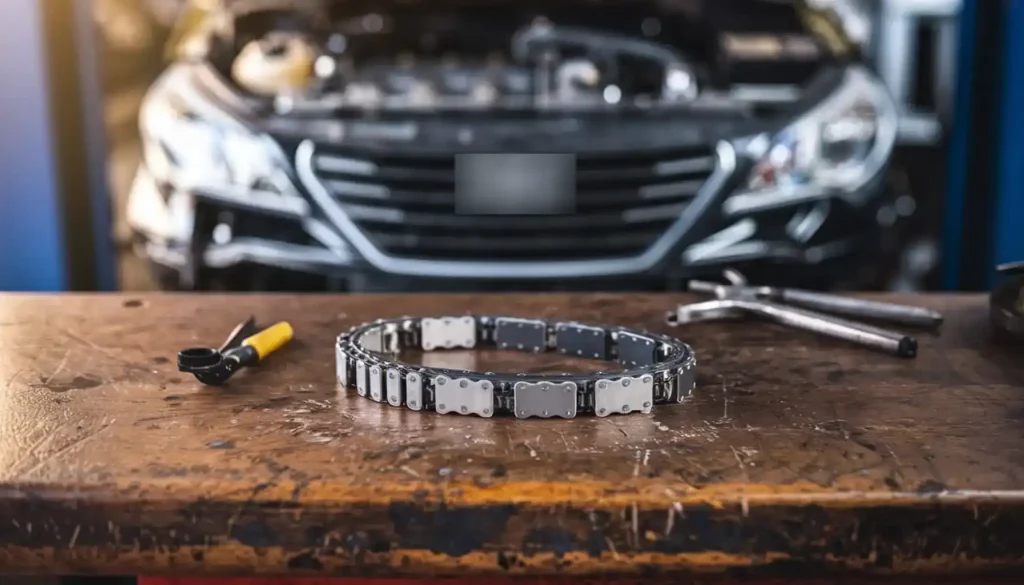
Worth noting, however, is that while timing chains may last longer than timing belts, they are not indestructible. With regular maintenance and proper care, the timing chain in your Hyundai may see considerably extended life-with many cases perhaps never needing replacement.
Our Experience with Timing Chain Failures in the Gulf
We have been supplying Hyundai parts all over Dubai and the Greater Middle East for more than 10 years. During this time, we observed timing chain failures very distinctly. This manual is a result of that practical experience which is made available to vehicle owners and mechanics in an easily understandable form.
As a parts independent specialist, i.e., a non-Hyundai affiliated entity, we are differently positioned to provide only those insights which are quite contrary from the data of component orders, technical consultations, and failure analyses in general.
Common Failure Patterns We Observe
Lambda V6 Engines (Santa Fe, Azera, Genesis)
In general, timing chain issues are in the range of 120,000-180,000 km with regular maintenance. Nevertheless, in cases where oil changes have been neglected or inferior lubricants have been used, we are frequently called upon to provide full replacements for less than 80,000 km of vehicles.
Main Warning Indication: Rattling from the front of the engine during cold start which gradually stops as the engine to heats up. This is a sign that the worn tensioners cannot take up the slack in the stretched chain anymore.
Theta II 2.4L Engines (Sonata, Tucson)
If well maintained, the chain in these engines will be good for over 200,000 km. If not, the chain break will be very early.
Signs of Trouble: Rough idle, misfires on different cylinders, slow performance loss.
Essential Realization
Most of the time, considerable wear is behind the door by the time the symptoms are heard. The chain has stretched, the tensioners are failing, plastic guides may be wearing off. Replacement at this stage is definitely not a choice.
Misdiagnosed Problems Often Confused with Timing Chain Issues
Due to the complex relationship between engine oil pressure, timing components, and performance sensors, timing chain issues can be mistaken for other faults:
| Confused Problem | Symptom Overlap with Chain Issues | Differentiation Method (Diagnostic Tools) |
| Low Oil Pressure | Low oil pressure (below at warm idle) prevents the hydraulic tensioners from fully pressurizing, causing chain slack and resulting noise. | Check the oil pressure switch and verify pressure manually. Check oil level and quality. |
| VVT Solenoid Faults | Faulty Variable Valve Timing components can cause poor performance or misfires. The ECU monitors the synchronizing status of the CKP (Crankshaft) and CMP (Camshaft) sensors [22PA, 13Kappa]. | Use a scanner (GDS) to check synchronizing status (CKP/CMP correlation) [13Kappa] and VVT Actuation status [13Kappa]. A VVT fault shifts the timing map, while chain stretch is physical deviation. |
| Knock Sensor Activation | Severe engine knock, detected by the piezo-type knock sensor [24PA], can sound like metallic mechanical noise but is actually abnormal combustion. The ECU responds by retarding timing (up to max) [24PA]. | Check knock adaption values per cylinder using a professional diagnostic tool [15Kappa, 24PA]. |
| Injector Issues | Poor performance or misfires are common signs of timing chain failure. However, these symptoms can also result from a problematic injector [49PA]. | Use the ECU’s Engine Test Function to perform an Injection Quantity Comparison test to identify problematic injectors via extreme correction values [49PA]. |
Do Hyundai Vehicles Have Timing Belt or Chain?
Not all Hyundai vehicles are equipped with a timing chain. Instead, certain models are older and others have different engine settings, which run on the concept of timing belts. You will have to refer to this in your vehicle’s manual or consult a certified Hyundai technician to find out if your car has a timing chain or belt.
This is critical information that one needs for planning in maintaining his vehicle, as timing chains are usually replaced less often compared to timing belts.
Most of the modern Hyundai models now use timing chains since they last longer and require minimal maintenance; nevertheless, it is always wise to consult your car specifically on what it was built with.
How Long Do Hyundai Timing Chains Last?
Timing chains on Hyundai models are supposed to outlast those made of timing belts. Where a timing belt would go through life from 60,000 to 100,000 kilometres and need a replacement, a well-cared-for timing chain may last up to 200,000 or even 300,000 kilometres or more. Of course, this is not a general rule. A number of factors can keep your Hyundai’s timing chain running well.
One of the main reasons timing chains tend to last longer is in their construction. Unlike rubber timing belts, timing chains are made of metal-usually an extremely durable alloy that can withstand the high-stress environment of an engine. Because timing chains are constructed of metal, they resist stretching and wear rather well in comparison to a rubber belt. The fact that timing chains also lubricate with the same engine oil reduces friction and wear, further extending their lifespan.
Are Timing Chains Hard to Replace?
Considering the critical nature of a timing chain in your Hyundai engine, one may wonder if replacing the timing chains is hard. Realistically speaking, unlike a timing belt replacement, changing a timing chain is generally more difficult and time-consuming. This is largely due to where a timing chain is located-inside the engine.
In most cases, timing chains are enclosed within an engine and, sometimes, at the front of the engine block behind the timing cover. Most timing chain replacements require the removal of several peripheral components such as the radiator, the water pump, and the oil pan being lowered in most cases. This then makes the replacement of the timing chain best left to experienced mechanics with proper tools and expertise.
Which Hyundai Engines Have Timing Chains?
Many of the newer Hyundai engines are indeed equipped with a factory timing chain on most of their latest model-lineups. What particular configuration this is, would depend on the exact model and year. Some popular models you may know of that have these chains in them are the Sonata, Santa Fe, Tucson, and Elantra, among others.
It should also be noticed that even the engines of the same model line may run off either a timing chain or a timing belt. A model might have its four-cylinder engine with a timing chain while the V6 version of the very same model may have a timing belt. Again, it means saying how important it is to look into your car manual or ask from a Hyundai professional what type is fitted in your car.
Why Timing Chains Fail
Understanding the motive for timing chain failure will also help in ways to prevent wear prematurely, thus saving you money.
Though, the timing chains could last longer, several other factors may cause the timing chain to fail, these are:
- Poor Oil Maintenance
- Wear of related components
- Manufacturing defects
- High mileage
When poor oil maintenance is used or degraded, this can increase friction and result in wear on the chain and related components. On the other hand, tensioners and guides keep the chain aligned and at proper tension. And as they wear, they may allow the chain to loosen or become misaligned; from this, additional wear and potential failure can be seen. While rare, these issues have been known to affect certain engine models across various manufacturers, including some Hyundai engines. And finally, very high mileage, even with proper maintenance, can eventually wear out the timing chain.
Being able to recognize some of the signs that the timing chain is going out can help you avoid complete catastrophic failure of the motor. Common signs include a rattling noise from the front of the engine, especially at start-up; poor performance or misfires in the engine; and, in extreme cases, the engine will not start at all.
Why Gulf Conditions Accelerate Wear
The timing chain is the one that is in contact with the engine oil. Thus, any factor that affects oil quality, will also to the extent that these factors affect oil, reminds chain life.
Extreme Heat
Rising temperatures in summer above 45°C make the oil to degrade faster. The all-aluminum construction of the Lambda V6 causes the engine to expand thermally in a different way than the chain which is made of steel.
Stop-and-Go Traffic
Prolonged idling without the cooling of the oil temperature results in a very high oil temperature, which is mainly responsible for the quick breakdown of the lubricant.
Short Trips
In the case of the engine which is never brought to the proper working temperature, oil pressure for the tensioner will not be developed.
Environmental Contaminants
Small particles of sand that get to the oil system, thus wear the engine parts that interact with the oil faster.
Oil Requirements That Actually Matter
Viscosity Selection
Hyundai prescribes 5W-30 for most of the engines. The 5W-40 is sometimes mentioned in the GCC as an alternative for extreme heat. It is best to consult the manufacturer’s guide of your vehicle—some engines can be just fine with 5W-30.
Quality Standards
Only meet the oil standards such as API SN/SP or ACEA A3/B4. What matters most is the certification rather than the brand that is producing the oil—good oils that meet these standards ensure hardly any wear.
Change Intervals
Factory recommendations of 10,000-15,000 km assume moderate conditions. For Gulf driving, we recommend:
- Standard driving: 7,500-10,000 km or 6 months
- Severe conditions (frequent short trips, heavy traffic, dusty areas): 5,000-7,500 km
This isn’t about selling more oil—it reflects what we see in failed versus long-lasting components.
Diagnostic Warning Signs
Electronic Codes
The ECM monitors crankshaft-to-camshaft timing correlation. Key trouble codes:
- P0016/P0017 (Bank 1) and P0018/P0019 (Bank 2): Indicate timing deviation beyond acceptable limits
Urgency
Most Hyundai engines are interference designs—valve and piston paths overlap. Severe timing deviation or chain breakage causes pistons to strike valves, potentially destroying the engine.
A code that could be fixed with chain replacement can become an engine replacement if ignored.
Physical Indicators
- Rattling/chattering at startup
- Check engine light with correlation codes
- Progressive performance degradation
- Rough idle that worsens over time
What Replacement Involves
Timing chain replacement is labor-intensive because the chain sits inside the engine block. The procedure requires:
- Removing radiator, water pump, accessories
- Removing timing covers and often the oil pan
- Precise timing alignment during installation
- Complete reassembly and fluid refill
Labor Time: 8-15 hours depending on engine and complications.
Parts Requirements
Replace the complete system together:
- Chain
- Tensioner(s)
- Guide(s)
- Sprockets (when worn)
- All disturbed gaskets and seals
Critical Note for Lambda V6: Revised parts numbers are available for chains and sprockets. Since crankshaft sprocket tooth diameter differs between old and new designs, it is not possible to mix them. Premature failure is caused by the use of mismatched components.
How to Replace Hyundai Timing Chains
It should be strongly emphasized that for anyone interested in learning how to replace Hyundai timing chains, it is a job that should be left to the professionals. The process generally involves the following steps:
- Removing a number of engine components in order to provide easy access to the chain
- Alignment of the engine to a correct position for timing
- Removing the old chain along with tensioners and guides
- Installation of new components
Reassembly of the engine with correct timing and tension. For these procedures, one needs a whole lot of specific tools and also thorough knowledge regarding mechanics of an engine. Without this knowledge and the necessary equipment, any incorrect DIY replacement of the timing chain will mean serious damage to your engine .
Why Are Timing Chains So Expensive?
A great percentage of the cost covers the replacement of the timing chain, which is quite a complex procedure. You may wonder why timing chains are very expensive to replace. The cost is higher for several reasons, including:
As earlier mentioned, most replacements require that an engine be substantially taken apart-a task that translates into hours of time and experience. In many cases, the replacement entails not only the chain but also tensioners, guides, and even sprockets. Proper timing chain replacement requires profound knowledge in engine mechanics and specific Hyundai models. And, you should know that during the replacement process, mechanics can find other worn components that may need attention.
These can be fairly expensive upfront to replace compared to chains, but again, that has to be put into perspective: chains have very long, durable lives. Comparing how often they would need replacement to a timing belt, the overall cost at the end of the vehicle’s life could be comparable or even lower with a timing chain.
When examining the quotes, look for:
- Complete kit included (chain, tensioners, guides)
- All gaskets and seals included
- Parts quality indicated (genuine or which aftermarket brand)
The Cost of Waiting: A preventive chain change is always cheaper than waiting for a chain to break. Replacing an engine after a broken chain is several times more expensive—plus it can create dangerous situations if the engine stops working in traffic.
Preventive Maintenance Schedule in UAE Conditions
Hyundai owners in the Middle East face unique difficulties due to climatic and driving conditions (high heat, stop-and-go traffic). These conditions accelerate oil degradation, which is the primary cause of timing chain wear.
| Maintenance Task | Recommended Action for Longevity (Interpreted for Harsh Conditions) |
| Oil Change Interval | While standard interval might be 9,000 miles/12 months (e.g., Theta 2.4L), anecdotal evidence suggests strict, shorter intervals, such as every 5,000 miles with Full Synthetic oil, correlated with original chain longevity past 300,000 miles. |
| Chain Inspection Interval | Timing chains are ideally designed to last the life of the engine. However, regular check-ups with a certified technician are advised to spot probable problems early. An inspection involves checking for audible noise. |
| Tensioners, Guides, VVT | Inspect these components when audible noise (rattling) is present. If replacement is necessary, all related components (chain, tensioners, guides) should be replaced simultaneously for maximum system life. |
| Driving Habits to Avoid | Avoid poor oil maintenance or using degraded oil, as this increases friction and wear. Stop-and-go traffic and high ambient heat (unique difficulties in Dubai/UAE/Middle East) accelerate wear and stress on the lubricant. |
The Hyundai USA website lists recommended service schedule for its models but directs users to the owner’s manual for exact details. you can choose your vehicle model, then find the right time for timing chain or belt maintenance.
Our Recommendation
Don’t think of the timing chain as something that might break and you won’t be able to predict it. Quality oil changes using good lubricants, taking care of the symptoms and your quick reaction to the codes related to the timing will help you get the most out of your chain.
If you see the symptoms or get the codes, don’t hesitate to take action. The repair you have to do today is always less expensive than the engine replacement you’ll have to do tomorrow.
Hyundai Timing Chain Reliability in 2025: Which Engines Are Truly Low-Risk—and Which Need More Care?
The performance of Hyundai engines throughout the UAE and the whole Middle East has gone through a major revision during the last 20 years, however, timing chain reliability still hinges on a mix of engine design, oil pressure, and owner’s maintenance. The data from ArsinTrading recorded in 2025 that is a combination of customer inquiries, OEM service documentation, and field-level technician feedback reveals one thing very clearly: today’s Hyundai chains are robust, but they are not entirely free from the need to be serviced – especially in Dubai’s extreme heat.
Hyundai Timing Chain Reliability vs Toyota, Nissan, Kia
Direct, real-world comparative data regarding timing chain reliability specific to Toyota, Nissan, and Kia under GCC conditions (high heat, sand) is not available in the provided sources.
However, based on shared engineering and general principles:
| Manufacturer/Engine | Timing Mechanism | Shared Engineering/Reliability Trend (Based on Sources) |
| Hyundai (Modern I4/V6) | Timing Chain | High durability expected (up to 300,000 km+). Highly vulnerable to failure caused by poor oil quality and extended drain intervals. |
| Kia (Theta II, Lambda) | Timing Chain | Kia and Hyundai share common engine families, such as the Theta 2.4L and Lambda V6, meaning they rely on identical timing chain technology. Reliability is therefore expected to follow the same oil maintenance dependence as Hyundai. |
| Toyota/Nissan | Not specified in sources | No specific data or analysis of their chain reliability is included in the sources for comparison. |
| Hyundai (Older Models) | Timing Belt (Epsilon 1.1L, Older 2.0L Beta) | Low reliability for the timing components if service intervals are neglected (e.g., replacement needed every 60,000 miles, failure can be catastrophic). |
Engines With the Lowest Timing-Chain Risk
The Lambda V6 (3.0–3.8L) and the latest Smartstream G engines (1.6T, 2.5L) appear to be the most stable over the long-term period. Their chains are designed to be used for a lifetime, as long as oil pressure is good and lubrication of the OEM-spec is kept. In the case of Smartstream engines, the very precise timing hardware (CVVT/CVVD) uses oil that is clean and stable in order to avoid the situation in which wrong timing changes are detected which in turn can be interpreted as chain wear. It is reported from the field that these engines are going beyond 250,000–300,000 Km with only a slight noise of the timing area when they are serviced in the right way.
Early Warning Sounds with Audio-Style Descriptions
Timing chain failure sounds signal that components have stretched or lost tension, risking engine damage
| Sound Description | Component Condition Indicated | Urgency |
| Metallic Rattling for 1–2 seconds at Cold Start | Initial start-up noise indicates the hydraulic tensioner is failing to hold oil pressure or the chain is stretched, causing slack until oil pressure builds up (the sound is a “rattling noise from the front of the engine, especially at start-up”). | High. Indicates system wear. |
| Diesel-like Clatter Under Load or Acceleration | Often related to general “knocks” or severe chain slack allowing the chain to slap against the guides, especially under varying torque loads. Poor engine performance or misfires are typically noted with this symptom. | Very High. Stop driving immediately if severe. |
| Rhythmic Ticking (Continuous) | May indicate worn tensioners and guides allowing the chain to loosen or become misaligned. Ticking/knocking can also be a general engine problem. | High. Requires immediate professional inspection. |
How to Reduce Timing Chain Noise Without Replacing It
Timing chain noise often indicates slack caused by stretch or failing tensioners/guides. Since the chain system relies entirely on engine oil for lubrication and hydraulic tensioning, non-replacement methods focus on optimizing the oil system:
| Method | Insight and Rationale | Citation |
| Changing Oil Grade/Quality | Using “quality oil” and maintaining strict change intervals is the single most effective preventive measure. The tensioners rely on oil pressure (normally at warm idle). Degraded or poor-quality oil increases friction, leading to chain wear and slack. | |
| Using OEM Tensioners | Tensioners and guides keep the chain aligned and at proper tension. While this involves replacement, ensuring replacement components are high-quality OEM or equivalent is necessary for proper tension management and system life. | |
| Checking VVT Solenoids | Engines use Variable Valve Timing (CVVT or Dual CVVT). If VVT solenoids or related actuators fail, they can disrupt the valve timing signal (CKP/CMP correlation), mimicking chain stretch [22PA, 15Kappa]. | [53, 62, 15Kappa] |
| Adjusting Idle RPM | Idle speed control is managed by the ECU (via the ISA) [27PA]. Ensuring the engine maintains its targeted idle speed (e.g., 680–880 rpm for diesel in diagnostics [43PA, 14Kappa]) is vital for maintaining required warm oil pressure. | [19, 27PA, 43PA] |
Engines With Moderate to High Sensitivity
The Theta II (2.4L) and the Nu/Gamma series (2.0L/1.6L) are very dependent on correct oil viscosity as well as are strict in regard of the maintenance intervals. They are strong in a mechanical sense, but their tensioners are reported for a startup rattle occurrence that can become worse if oil is severely degraded – this is a problem that has been mostly found in the GCC region. Such signs of an issue are incorrectly understood as “chain stretching” even though the main problem lies in oil-pressure instability or VVT solenoid lag.
Hyundai platform with timing belts such as those in early Elantra and Accent models have always been the most high-risk category, and they continue to be so. The belts can fail in a violent manner if the 60k-mile interval is not adhered to– which is still a quite frequently made mistake by owner’s inattentive to the budget.
2025 Distinguishing True Chain Wear from Misdiagnosis
In the year 2025, workshops in Dubai and Sharjah have found that most of the people who come with “timing chain problems” are VVT solenoid faults, low oil pressure, unreliable knock sensors, or injector imbalance. Before a chain overhaul is decided upon, a professional diagnostic scan (CKP/CMP correlation, VVT actuation, knock adaptation, injector correction values) is imperative nowadays.
Maintenance Rules for UAE Drivers
In high-heat environments, Hyundai engines benefit from:
• 5,000–6,000 mile oil changes (full synthetic only)
• Regular tensioner/guide inspection when early startup rattle appears
• Avoiding mixed old/new chain components—critical on Lambda V6 engines
• Using only OEM-grade chain kits for maximum lifespan
Engines Are Most & Least Prone to Timing Chain Issues (2025 Data)
| Engine Family | Status (Chain/Belt) | Reliability Insight (Based on Maintenance/Design) |
| Lambda V6 (3.0L – 3.8L) | Timing Chain (Metal) | All versions of this all-aluminum V6 use a timing chain. The long-term durability of the chain is contingent on proper lubrication. Note that new and old timing chain/sprocket part numbers must not be interchanged due to different crankshaft sprocket tooth root diameters. |
| Theta II (2.4L, G4KJ, G4KE, etc.) | Timing Chain (Metal) | Uses a timing chain to drive both intake and exhaust camshafts via dual CVVT. Engine problems, including noise/knocks, are noted in this series. Longevity hinges entirely on using quality oil to prevent wear and maintain tensioner function. |
| Nu 2.0L / Gamma 1.6L | Timing Chain (Metal) | Found in models like the 2016+ Tucson, both engines use a timing chain. These modern chains are designed for high mileage but are susceptible to failure from poor oil maintenance. |
| Smartstream G Engines (2.5L, 1.6T) | Timing Mechanism not specified in provided specs. | These modern DOHC engines (2025 Tucson) follow the modern trend toward chain systems. They utilize advanced timing control (CVVT or CVVD). |
| Older Engines (e.g., Elantra 2.0L, Accent 2009) | Timing Belt (Rubber) | These older interference engines (e.g., G4DM, G4GC, G4GF, G4GM) require replacement every 60,000 miles or 48 months to prevent catastrophic failure. |
Conclusion
It is very vital to comprehend the function and demands your Hyundai timing chain has with respect to maintaining your car in prime working condition while saving you from inconvenient and costly repairs. Though timing chains are intended to last long, they are never resistant to wear and tear and will likely reach a point where replacement may be necessary. By doing routine maintenance-such as regular oil changes with quality oil-your timing chain and other parts inside the engine can really last longer.
Being a Hyundai owner in Dubai of the UAE or Middle East, you are most likely to face unique difficulties arising because of the climatic and driving conditions in this region. Regular check-ups with a certified Hyundai technician will help you to spot any probable problems early on and save your time and money in the longer run. Keep in mind that anything related to timing chain replacement or major engine works always requires professionals with the right tools and art.
And if you need to buy timing chains or any Hyundai Spare parts in Dubai, UAE, or other countries in Middle East, you can Call our sale support team at Arsintrading, We at Arsintrading bring high quality spare parts for Hyundai and Kia from best brands in Dubai and all over the region.
It pays to stay informed about the different components of your car and proactive in maintaining them in good order for your Hyundai vehicle to run as efficient and reliable as you have become accustomed to. It may be in the busy city of Dubai or elsewhere on a long drive through the UAE, but a well-maintained timing chain will ensure the heart of your Hyundai continues to keep running for many years to come.